Three metrics, three different questions
Cost per click, cost per thousand impressions, and click-through rate describe different parts of a campaign. CPC asks what each recorded click cost. CPM expresses spend per thousand recorded impressions. CTR describes the share of impressions associated with clicks. None of them alone tells you whether sales were profitable.
A useful way to learn the differences is to calculate all three from the same dataset. Use the same campaign, dates, currency, and reporting scope. Otherwise, a small denominator change can look like an improvement that did not actually occur.
Use one set of campaign numbers
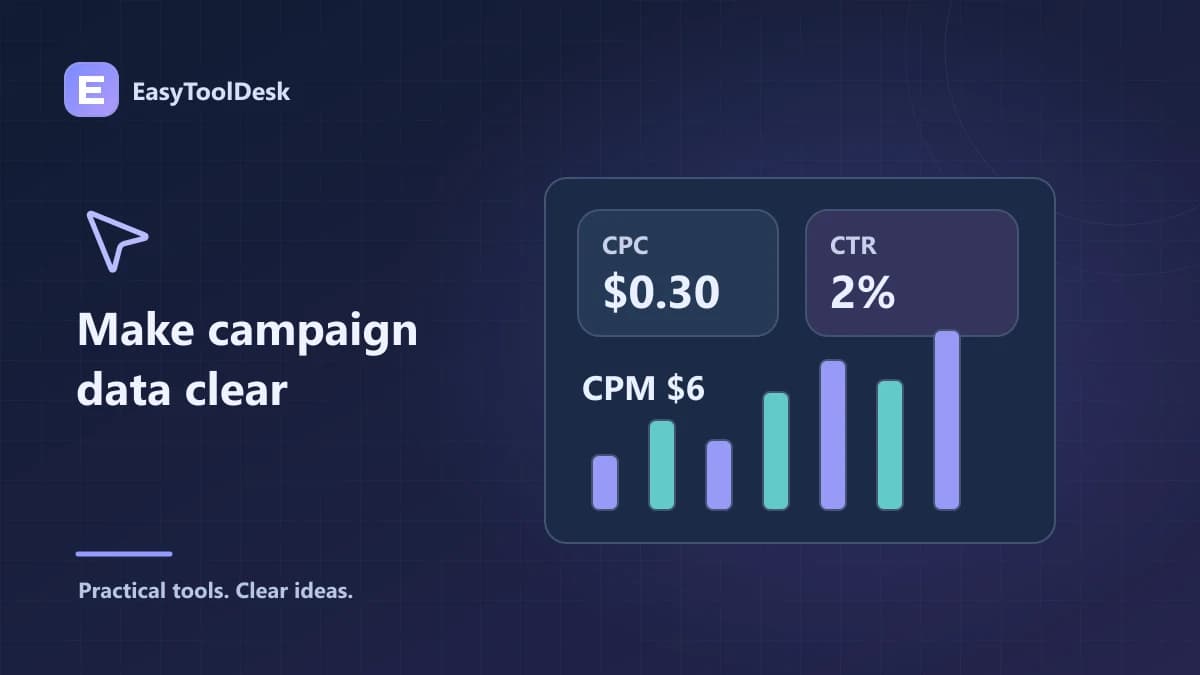
Suppose a campaign records 100,000 impressions, 2,000 clicks, and $600 of spend. CPC = spend ÷ clicks, so $600 ÷ 2,000 = $0.30 per click. The average hides variation between individual clicks, but it summarizes the period’s spend relative to the click count.
CPM = spend ÷ impressions × 1,000. In this example, $600 ÷ 100,000 × 1,000 = $6 per thousand impressions. CTR = clicks ÷ impressions × 100, giving 2,000 ÷ 100,000 × 100 = 2%.
Understand how the measures interact
Keeping CPM fixed while increasing CTR can reduce average CPC because the same impression spend produces more clicks. That relationship does not establish that the additional clicks are valuable. A clearer message might attract more relevant visitors, while an exaggerated message might attract clicks that never turn into useful outcomes.
Imagine the campaign generates 40 recorded purchases. Click-to-purchase conversion would be 40 ÷ 2,000 × 100 = 2%, and spend per recorded purchase would be $600 ÷ 40 = $15. Those calculations add context, but revenue, fulfillment costs, and attribution still need attention.
Common reporting mistakes
Do not use unique reach in place of impressions unless you deliberately want a different metric.
Keep clicks from one campaign separate from impressions belonging to another.
Remember the ×1,000 factor in CPM and the ×100 factor in percentage CTR.
A zero click or impression denominator makes the corresponding ratio undefined.
Compare placements and objectives that are reasonably similar before interpreting a change.
For advertising-platform context, see Google Ads guidance on campaign metrics.
Frequently asked questions
Can a lower CPC make a campaign worse? Yes. Cheaper clicks can coincide with fewer relevant visitors or a lower purchase rate. Review downstream outcomes rather than optimizing a click price in isolation.
Is there a universal ideal CTR? No. This article provides arithmetic, not a benchmark. Intent, placement, audience, and measurement method can change what a percentage means.
Continue with conversion rate with consistent denominators to connect clicks or visits with a defined outcome.