Compare acquisition cost with a defined customer value
Customer acquisition cost estimates the sales and marketing spend associated with acquiring a new customer. Customer lifetime value is a model of value over a relationship. The comparison can support planning, but only when the cost scope, customer cohort, and type of value are clear.
In EasyToolDesk, the lifetime-value calculator estimates gross profit from average order value, orders per year, customer lifespan, and gross margin. It is not a discounted cash-flow model or a promise that every newly acquired customer will follow the same pattern.
Calculate a simple CAC
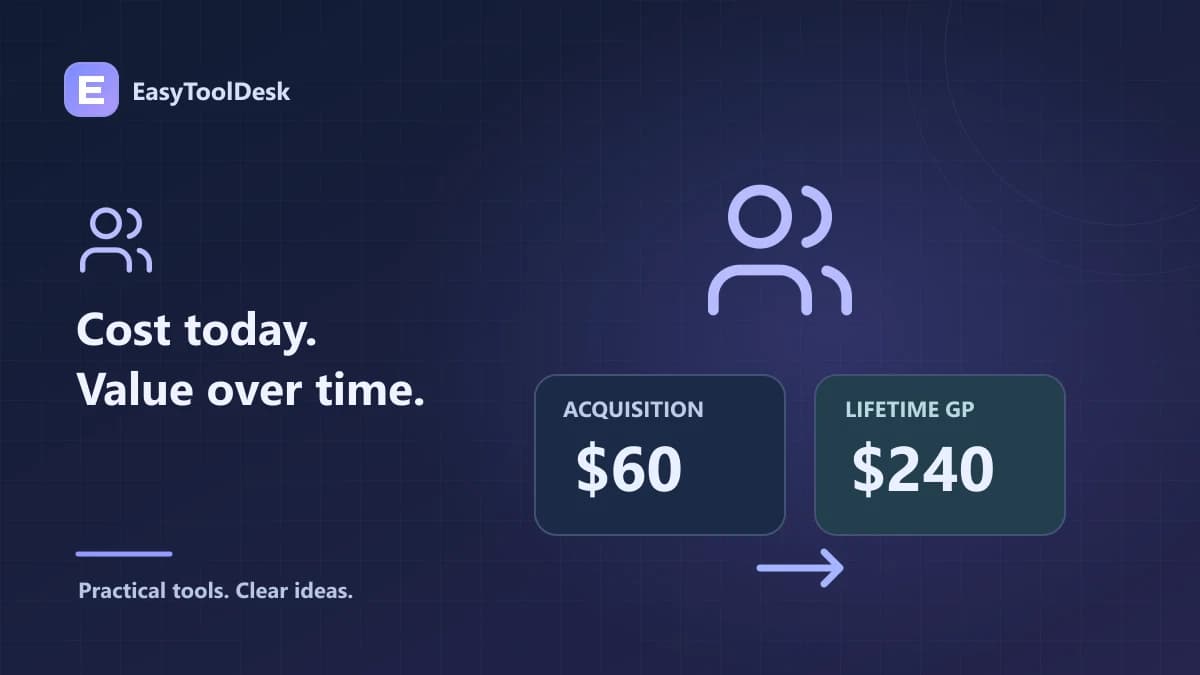
Use CAC = included sales and marketing costs ÷ new customers acquired. If the included costs for a period are $6,000 and 100 new customers are attributed to that effort, CAC is $60. Document whether the cost total includes agency work, staff time, creative production, and other relevant expenses.
An advertising-only cost per customer may be useful, but it is narrower than a fully loaded acquisition estimate. Do not compare a narrow cost from one channel with a broader cost from another and interpret the difference as efficiency without checking what each includes.
Build a gross-profit lifetime estimate
Assume an average order value of $50, four orders per year, a three-year relationship, and a 40% gross margin. Modeled revenue is $50 × 4 × 3 = $600. Applying the 40% margin gives an estimated $240 gross-profit lifetime value under constant assumptions.
Against a $60 CAC, the simple gross-profit LTV-to-CAC ratio would be 4:1. The ratio still excludes expenses beyond the chosen gross-margin definition, the timing of cash receipts, and uncertainty about customer retention. It should not be treated as a universal spending permission or a guaranteed outcome.
Use scenarios rather than one optimistic number
Repeat the model using a shorter customer lifespan.
Check whether order frequency changes after the first year.
Keep discounts and returns consistent with the average order value used.
Match acquisition costs and customer counts to a defensible cohort or attribution method.
Consider when acquisition spending is paid compared with when gross profit arrives.
For example, reducing the modeled lifespan from three years to one year cuts the gross-profit estimate from $240 to $80. The acquisition cost remains $60 in this scenario, leaving a much narrower relationship than the original ratio suggested.
Frequently asked questions
Is a 3:1 or 4:1 ratio automatically healthy? No. There is no universal threshold in this article. Cash timing, operating costs, retention uncertainty, and how each input is defined can change the interpretation.
Can I use existing customers in the CAC denominator? Not when you intend to measure cost per newly acquired customer. Use an explicitly named retention or blended measure if the denominator includes another population.
For campaign-level measurement, compare ROI and ROAS alongside these customer-level estimates.