What the payment model assumes
A standard fixed-payment loan estimate spreads repayment of principal and interest across a specified number of equal monthly payments. The simplified model assumes a fixed annual interest rate, monthly periods, and payments at the end of those periods. Real contracts can include fees, payment timing rules, or other features that change the amount due.
Use the calculator to understand the arithmetic and compare clearly labeled scenarios. Treat the lender’s actual repayment schedule and contract as the source for the amount you owe, rather than assuming a generic calculator exactly reproduces it.
Work through a small example
Suppose principal is $1,000, the annual interest rate is 12%, and the term is 12 monthly payments. The model’s monthly rate is 12% ÷ 12 = 1%, or 0.01. The payment formula is P × r × (1 + r)^n ÷ ((1 + r)^n − 1), where P is principal, r is the monthly rate, and n is the payment count.
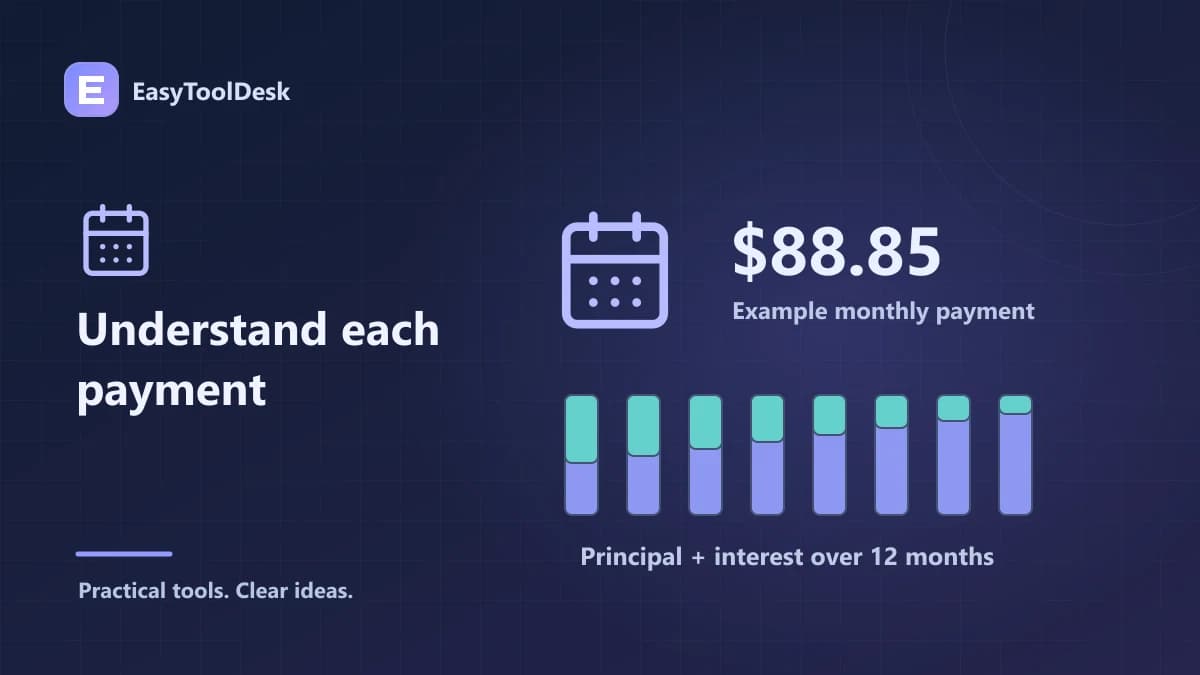
Using those assumptions gives a payment of approximately $88.85. Before rounding details, the first month’s interest is $1,000 × 0.01 = $10. The rest of that payment reduces principal. The next month’s interest is calculated on the remaining balance, so the allocation changes as the balance declines.
Why the interest share changes
For a normally amortizing fixed-payment loan, more of an early payment goes toward interest than later payments because the outstanding balance starts larger. That does not mean every payment is a different size; the split inside the fixed payment changes.
The CFPB’s explanation of amortization describes this distinction. A balloon payment, interest-only period, changing rate, or negative-amortization feature is a different arrangement and is not captured by the simple equal-payment formula here.
Compare term changes carefully
Extending a term while keeping principal and the assumed rate fixed can reduce the modeled monthly payment, but it also adds more payment periods. Review the total paid as well as the monthly amount. Any comparison should separately identify fees and charges omitted from the payment model.
Enter the number of monthly payments, not the number of years.
Use the annual rate expected by the tool; do not enter a monthly percentage as an annual figure.
At zero interest, the model reduces to principal divided by the payment count.
Expect possible final-payment adjustments when a real schedule rounds every period to cents.
Further reading: the CFPB explains loan amortization.
Frequently asked questions
Does the estimate include insurance or setup fees? No. This calculator uses principal, annual interest rate, and number of monthly payments. Add-on charges require separate treatment and may affect a lender’s disclosed cost measures.
Is interest rate the same as APR? Do not assume they are interchangeable. APR disclosures can account for additional costs under applicable rules, while this formula uses the entered interest-rate assumption.