The difference is the amount that earns interest
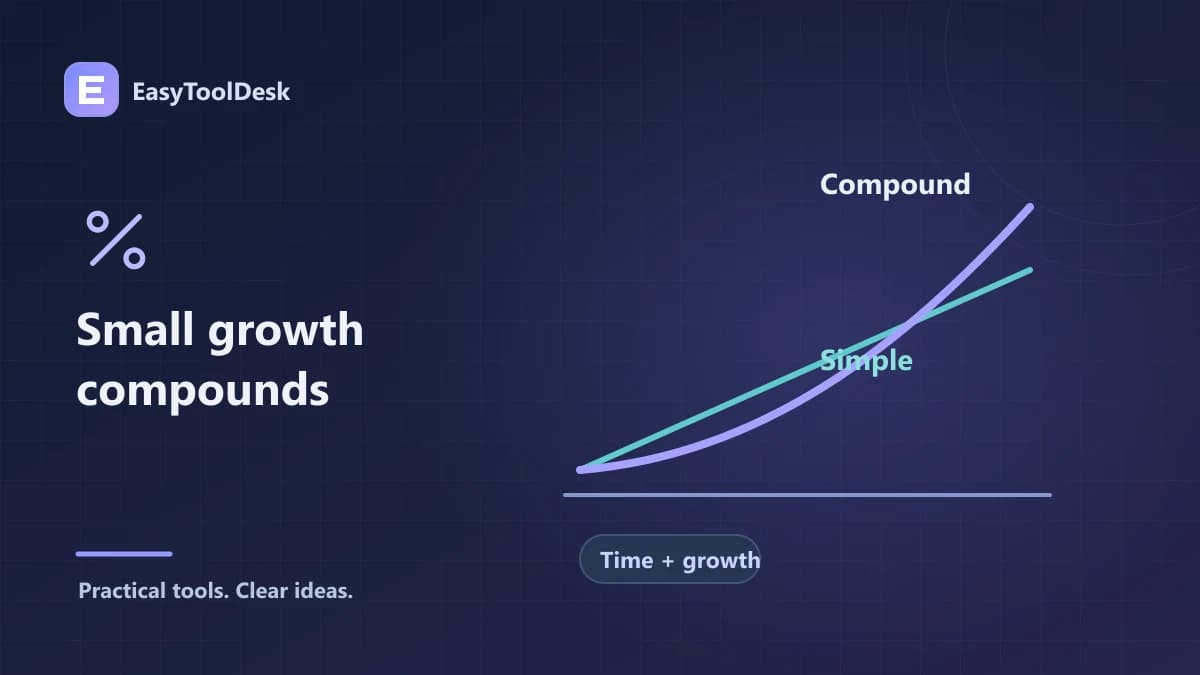
Simple interest is calculated on the original principal in the basic model. Compound interest includes interest that has already been added to the balance. Using the same starting amount and nominal annual rate can therefore produce different totals over time.
The Consumer Financial Protection Bureau describes compounding as earning interest on both the money saved and the interest already earned. The examples here are arithmetic illustrations using a fixed rate. They are not predictions of investment returns or a description of every loan contract.
Compare two three-year examples
Start with $1,000 at a fixed 5% annual rate for three years. Simple interest is principal × annual rate × years: $1,000 × 0.05 × 3 = $150. The final amount under that model is $1,150.
With annual compounding, the balance becomes $1,000 × 1.05 × 1.05 × 1.05 = $1,157.625, or $1,157.63 rounded to cents. The first year adds $50. The second year’s interest is calculated on $1,050, and the third year’s interest is calculated on the next increased balance.
Understand compounding frequency
For periodic compounding, future value = principal × (1 + annual rate ÷ periods per year) raised to (periods per year × years). Enter the annual rate as a decimal in the formula. The calculator accepts a percentage and converts it internally.
At the same nominal 5% rate, monthly compounding over three years uses $1,000 × (1 + 0.05 ÷ 12)^36, approximately $1,161.47. This comparison holds the nominal rate constant. It should not be used to compare an advertised annual percentage yield with a nominal rate as though the labels were interchangeable.
Know the model’s boundaries
The periodic-compounding tool assumes a fixed rate and no additional deposits or withdrawals.
Fees, taxes, inflation, and changing rates are not included.
Compounding periods per year must be a positive whole number.
A contract may use day-count conventions, payment timing, or rounding rules outside this simplified model.
For a savings plan with regular contributions, use a model that explicitly includes those contributions.
Further reading: the CFPB explains how compound interest works.
Frequently asked questions
Is more frequent compounding always the better option? Holding a positive nominal rate and the other assumptions constant, more frequent compounding increases the modeled balance. Actual comparisons still need the stated rate type, fees, terms, and purpose of the account.
Can I use this model for every loan? No. A fixed-payment amortizing loan needs a payment schedule model. Read the contract and distinguish it from a balance that simply compounds without payments.
For a different calculation, see how fixed monthly loan payments are estimated.