What break-even units tell you
Break-even units estimate how many items you need to sell to cover the fixed and variable costs included in a simple model. The calculation is useful for exploring a product launch, a monthly sales target, or a change in pricing. It is a planning estimate rather than a promise that enough customers will buy.
Choose a period before entering numbers. If fixed costs are monthly, use the costs and expected selling conditions for that same month. Mixing annual rent with one month of sales assumptions can make the result appear much harder to reach than the intended comparison.
Use the contribution per unit
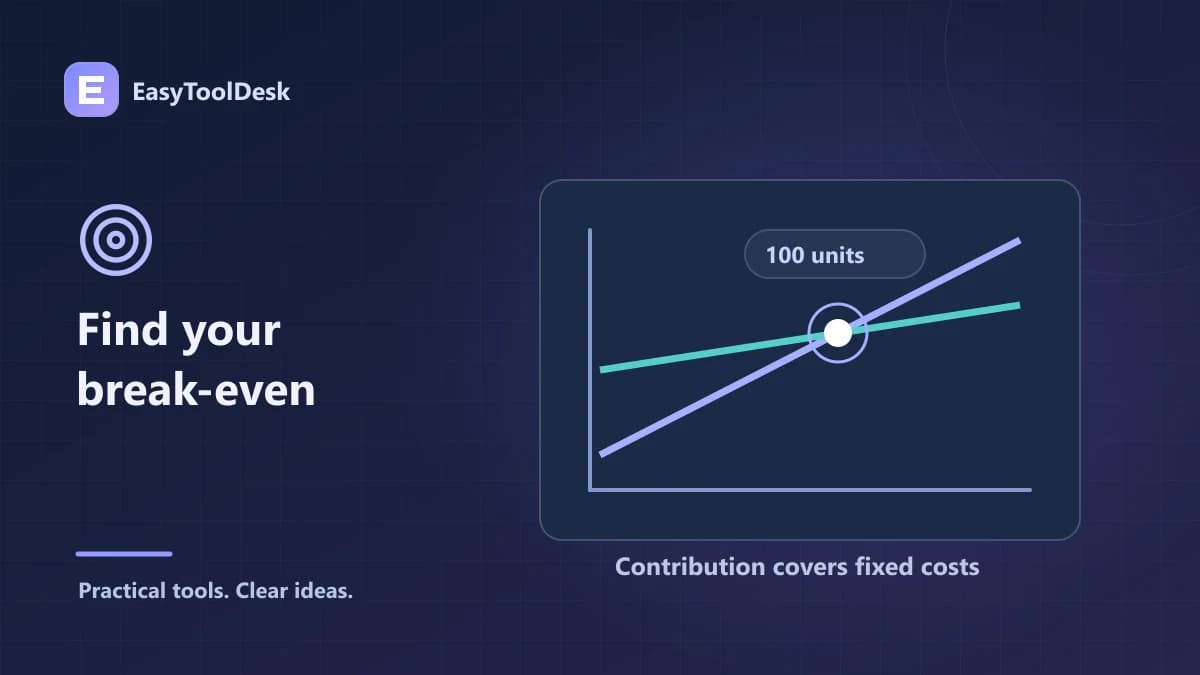
The formula is break-even units = fixed costs ÷ (unit selling price − variable cost per unit). The amount inside the brackets is contribution per unit. It is the portion of each sale available to cover fixed costs before the model reaches break-even.
Suppose monthly fixed costs are $2,000, selling price is $50, and variable cost is $30 per item. Contribution is $50 − $30 = $20. Divide $2,000 by $20 to get 100 items. Revenue at that volume is $5,000; variable costs are $3,000, leaving $2,000 to cover the stated fixed costs.
Round up and test another scenario
If the calculation produces 100.2 items, you normally need 101 complete items to cover the modeled costs. EasyToolDesk rounds whole-unit break-even upward. Selling only 100 items would leave a small shortfall rather than reaching the target exactly.
Now lower the example price to $45 while keeping costs unchanged. Contribution falls to $15, and $2,000 ÷ $15 is about 133.33. The required whole-unit volume becomes 134. The price changed by $5, but the sales target increased by 34 items because less of each sale is available for fixed costs.
Check the assumptions
Include variable expenses that rise with each sale, such as packaging and per-order processing costs.
Keep fixed costs constant only within a realistic operating range. Extra staff or space may change them.
For multiple products, a single-product estimate may not represent your actual sales mix.
A selling price at or below variable cost cannot cover positive fixed costs through additional volume in this model.
For the underlying unit formula, see the break-even point explanation from the U.S. Small Business Administration.
Frequently asked questions
Does break-even include a target profit? Basic break-even covers the stated costs. To explore a profit goal using the same assumptions, add that target to fixed costs before dividing by unit contribution, and identify the result as a profit-target calculation.
Can I use a revenue target instead? A revenue model uses a contribution margin ratio rather than contribution dollars per item. Check which form your report needs, and avoid substituting gross sales for contribution in the unit formula.
Before reducing your price, compare how discounts and profit margin change the amount each unit contributes.