Why cost plus a percentage can fall short
A selling price must cover the costs you choose to include, but some costs depend on the price itself. A payment fee of 3% rises when the selling price rises. Adding 3% to a cost subtotal is therefore not the same as reserving 3% of the final price for that fee.
A useful starting model separates dollar costs per unit from percentages of sales. This lets you explore a target contribution margin after the listed variable expenses. It does not decide what customers will pay or whether the product is commercially attractive.
List the dollar costs first
For this model, add unit cost, packaging, seller-paid shipping, and any fixed transaction charge. Suppose those amounts are $20, $2, $4, and $0.30. Your subtotal is $26.30 per sale. Check that a shipping cost has not already been included in the supplier price before counting it again.
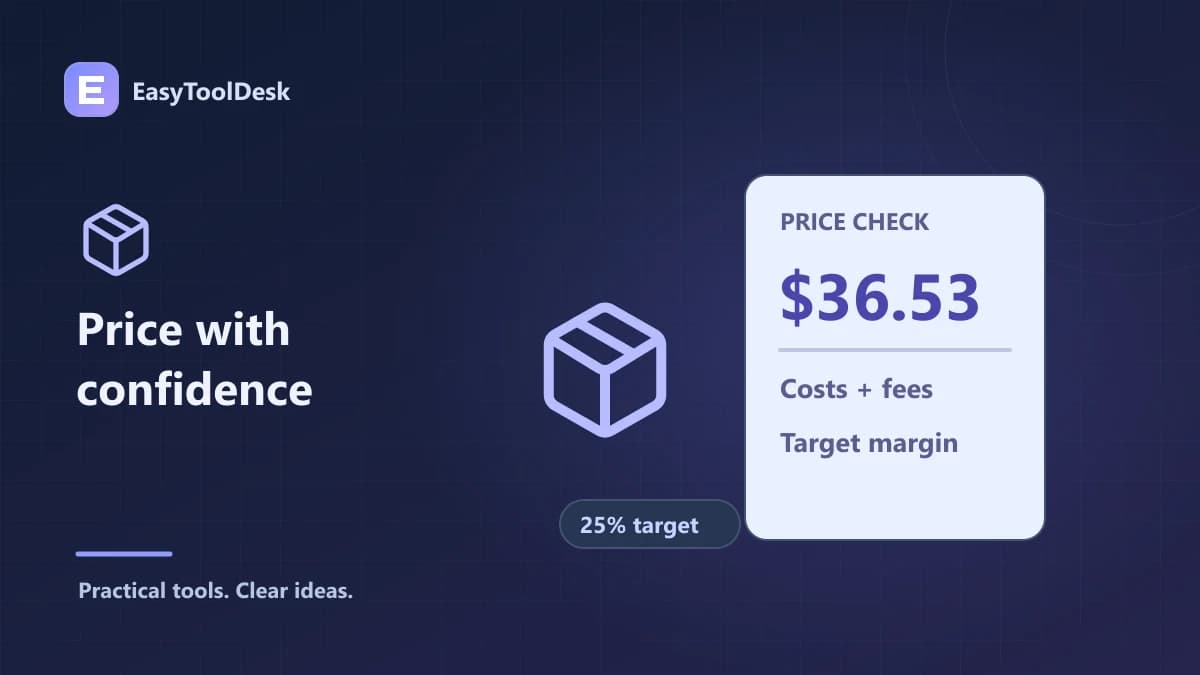
Next choose a percentage fee and a target margin. Assume a 3% fee and a 25% margin. Together they use 28% of the final price, leaving 72% to cover the $26.30 subtotal. The required unrounded price is $26.30 ÷ 0.72, or approximately $36.5278.
Verify the price rather than trusting the label
At an example rounded price of $36.53, a 3% fee is approximately $1.0959. Subtracting that fee and the $26.30 dollar costs leaves about $9.1341. Dividing that contribution by $36.53 gives roughly 25%. Actual payment providers may round fees at a particular stage, so reconcile the model with their statement.
The general formula is price = dollar cost subtotal ÷ (1 − fee rate − target margin), with percentages entered as decimals. The denominator must be positive. A 75% margin plus a 25% fee leaves no share of revenue for positive dollar costs, so the model has no workable price.
Expenses this example does not settle
Fixed overhead, such as rent or software subscriptions, is not automatically covered by a unit contribution target.
Advertising, returns, and marketplace charges must be included consistently if they apply.
Tax collection, tax treatment, and fee rules vary. Enter your applicable assumptions instead of treating this example as a tax calculation.
A discounted selling price requires a fresh check of the contribution after fees.
Cost calculations are one part of pricing. Business.gov.au also discusses choosing a pricing strategy.
Frequently asked questions
Is the target margin net profit? In EasyToolDesk’s product-pricing tool it is contribution after the listed variable costs and fees, before fixed overhead and income tax. Label it that way when comparing the result with an accounting report.
What if fees apply to a different base? This simplified model assumes the entered percentage applies to the selling price. If a provider applies fees to shipping, collected tax, or another amount, calculate those charges separately and adjust the model.
If the target percentage is unclear, review margin versus markup before entering it.