Start with the question you want to answer
ROAS measures attributed revenue relative to advertising spend. Simple ROI compares a net gain or loss with an investment amount. A campaign can show a high ROAS while producing little profit once product costs and other expenses are considered. Neither measure is useful without a clear definition of the numbers entered.
For reporting, keep a short note beside each figure: the dates covered, the attribution rule, the revenue definition, and the costs included. This makes a comparison between campaigns more meaningful than treating a platform’s headline multiple as a complete business result.
Calculate ROAS from revenue and ad spend
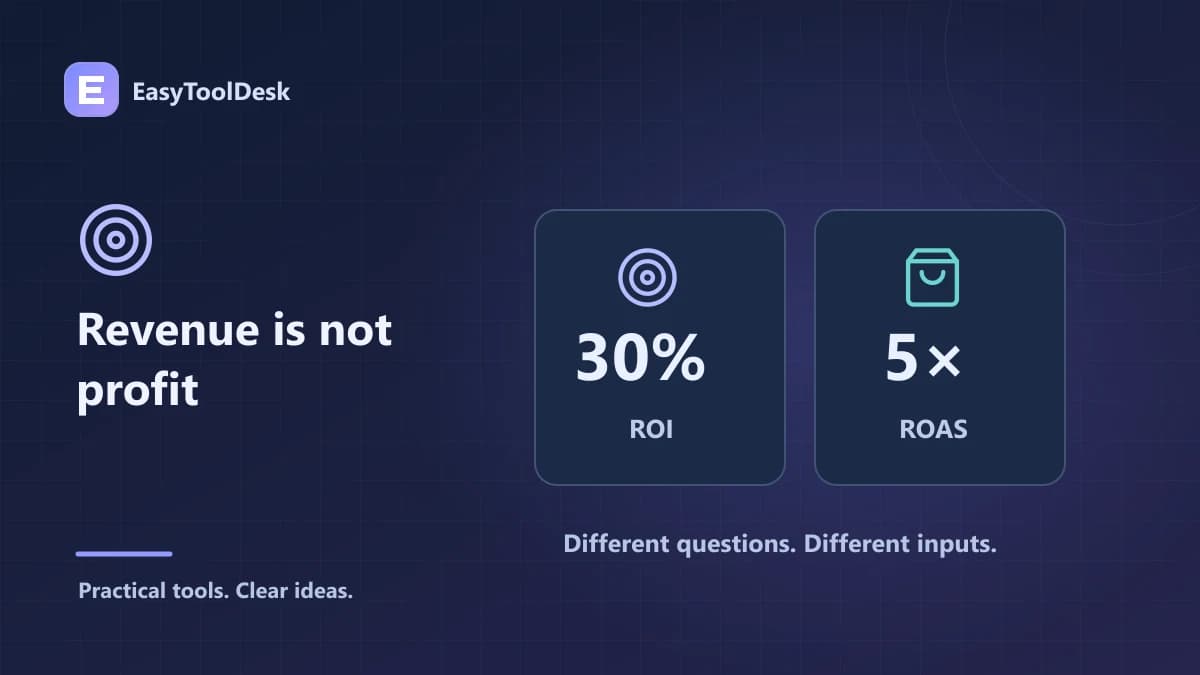
ROAS = attributed revenue ÷ ad spend. If a campaign is credited with $5,000 revenue and costs $1,000 in advertising, its ROAS is 5×, also expressible as 500%. That means $5 of attributed revenue for each $1 of advertising spend, not $5 of profit.
Suppose fulfilling those orders costs $3,200 before advertising. Subtracting fulfillment costs and the $1,000 ad spend from $5,000 leaves $800 before other excluded expenses. The same 5× ROAS can therefore coexist with a much smaller amount available to cover overhead.
Define a simple ROI example carefully
For a separate project example, invest $2,000 and receive $2,600 in total value using your chosen definition. Simple ROI is ($2,600 − $2,000) ÷ $2,000 × 100 = 30%. The calculation requires total return value, rather than entering the $600 gain as though it were the total amount received.
EasyToolDesk’s ROI tool uses this total-value convention. It does not annualize the result or calculate an internal rate of return. Two projects with a 30% simple ROI can have very different cash-flow timing, durations, and risks.
Avoid comparing incompatible reports
Use the same attribution window when comparing ROAS across campaigns.
State whether revenue excludes refunds, discounts, and collected tax.
Do not subtract advertising twice when building a profit-based comparison.
Separate a platform-attributed result from evidence that advertising caused incremental sales.
Compare investment periods and timing before interpreting simple ROI.
To connect campaign revenue with unit economics, calculate break-even ROAS from contribution margin.
Frequently asked questions
Is a 5× ROAS always good? There is no universal answer. A business with very low contribution before advertising may need a higher multiple than one with more contribution per revenue dollar. Fixed costs and the reliability of attribution also matter.
Can I call ROAS campaign profit? No. ROAS has revenue in its numerator. If you want a profit statement, calculate the relevant costs separately and name the resulting measure accurately.